
Curatorial Statement
Exhibition Posted Online: Monday, August 10, 2026 at 10 am MT
Marty Fielding became captivated by clay as an anthropology major at the University of North Carolina at Greensboro. He continued his study of ceramics as a teaching assistant at Penland School of Crafts. Fielding worked for decade as a studio potter prior to earning an M.F.A. from the University of Florida.
Fielding’s work has been included in invitational and juried exhibitions locally, nationally and internationally such as Strictly Functional and The Zanesville Prize.
Fielding teaches at Florida State University. His teaching experience includes SUNY New Paltz, Middlebury College, and the University of Georgia Studies Abroad Program in Cortona, Italy as well as community studios including Frog Hollow in Middlebury, Vermont where he was Resident Potter. He has taught workshops including Penland, UMass Dartmouth, and Truro Center for the Arts.
His work and writing are published in numerous books and periodicals including the recently published Creative Pottery by Deb Schwartzkopf, Low Fire Sodaby Justin Rothshank, and Fielding’s article, Contextualizing Ceramic Color in Ceramics Monthly.
My exploration of the ceramic vessel currently represents two related yet distinct bodies of work. Both series encourage reflective interaction with the pieces.
My ceramic vessels combine architecture, abstract painting, and color interactions to question the conventions of archetypal pottery forms. The vessels provide a platform for conveying and evoking emotional reactions. I construct re-imagined vessels comprised of intersecting geometric shapes that use exaggerated proportions and visual mass to communicate a sense monumentality despite their modest scale. I use this framework as a basis for investigating two bodies of work.
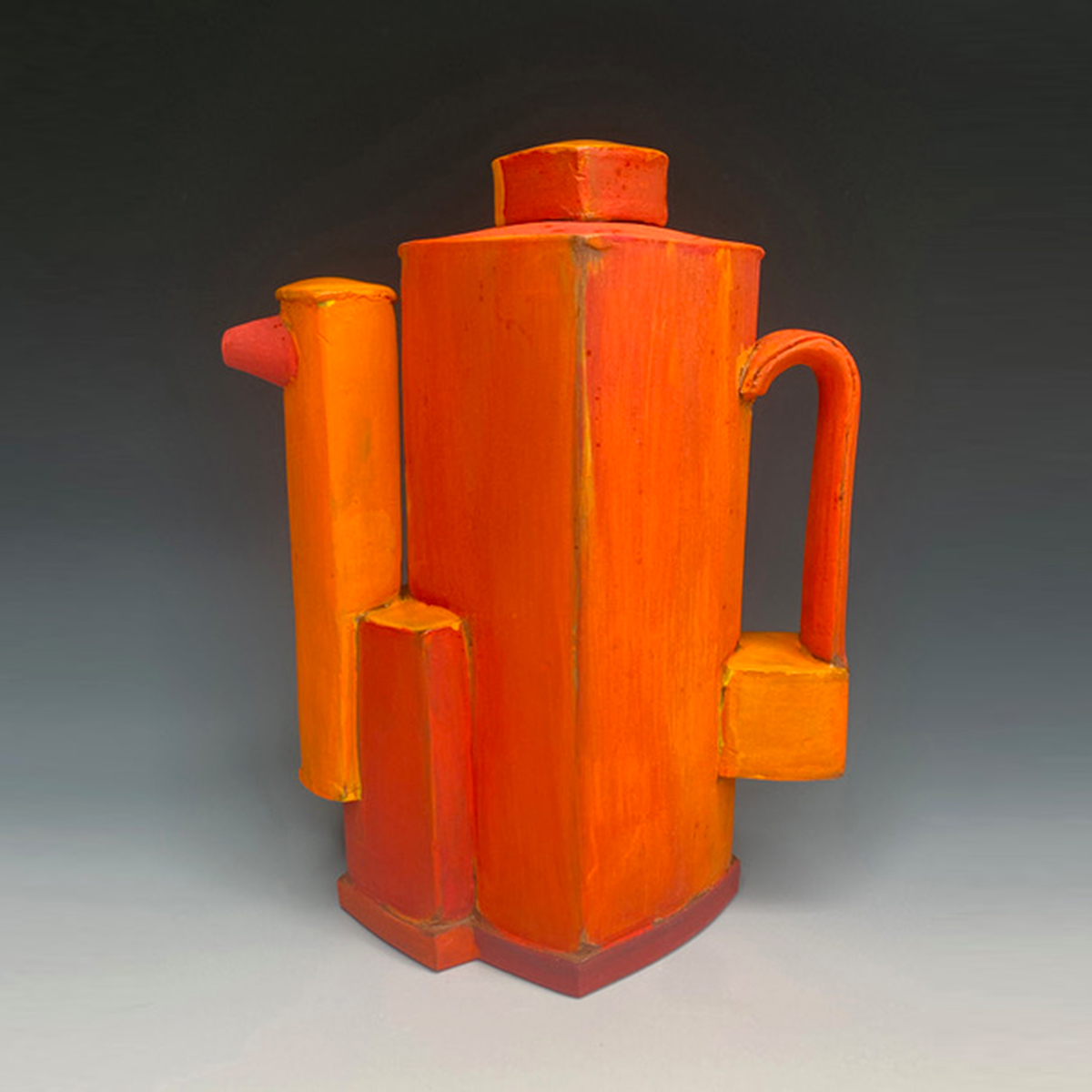
In the first series, abstracted vessel forms are defined by bold color, giving them the presence of utilitarian 3-dimensional Color Field paintings. These forms are draw on modernist architecture and meant to be used in domestic spaces. Their unconventional appearance may require an adventurous approach when putting them into use.
The functional parameters of the vessel allow me to achieve two important goals: offering individuals an interactive experience through use and questioning the aesthetic conventions of the archetypal pot within the framework of utility. By reimagining a teapot or liquor service through an architectural lens, the form is abstracted to the point where it is simultaneously unfamiliar and recognizable. A moment of discovery is offered to entice the viewer to investigate further through sight, touch, and use. Rather than stepping back from a painting to see it more clearly, the tabletop scale of the work demands zooming in to close proximity to enter an immersive experience.
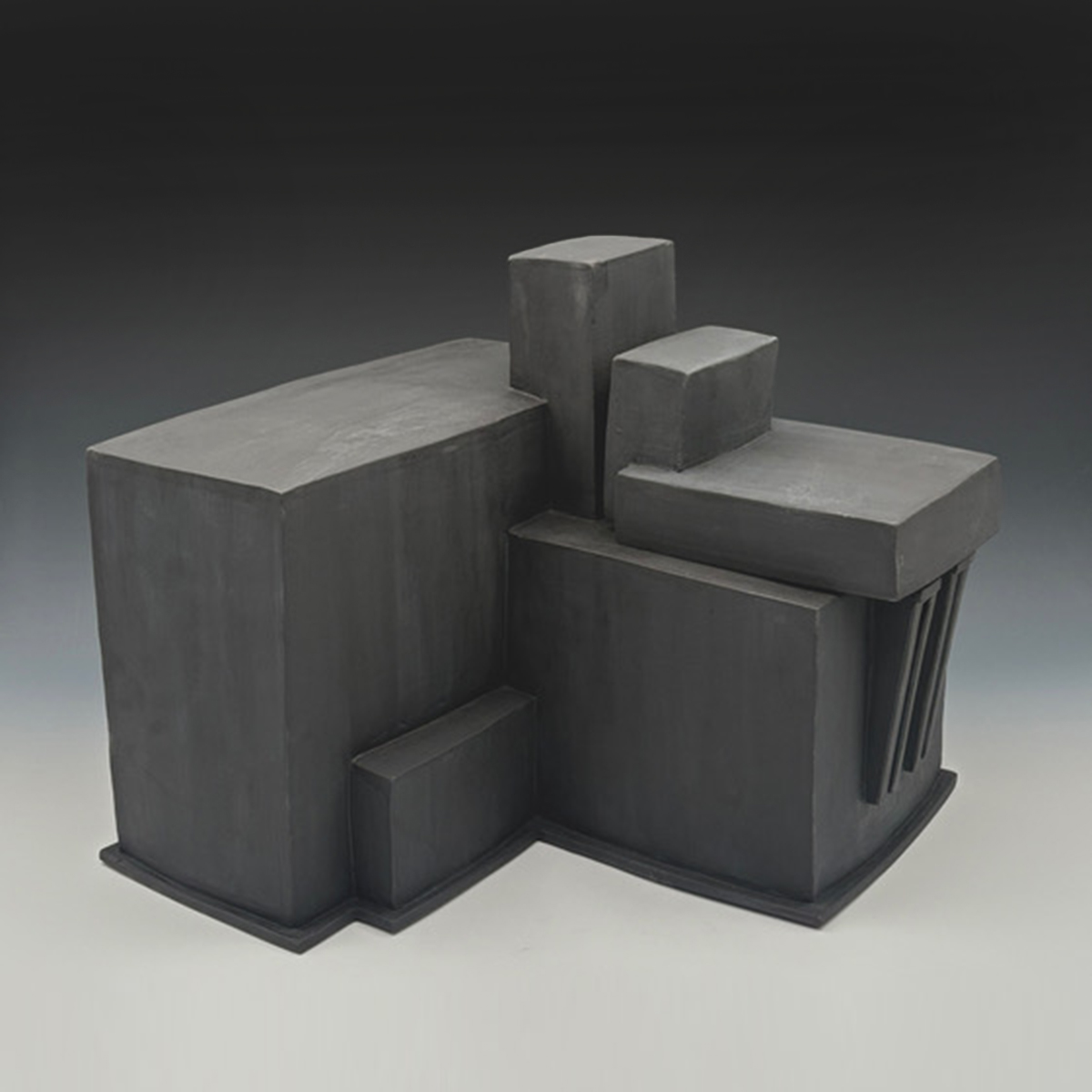
The second body of work examines how bereavement can be expressed through the context of a ritual object such as an urn or candle votive. Grieving is a universal experience that involves numerous emotions. As such, it has the potential to be applied to concepts like the loss of a societal consensus of truth in addition to the literal mortality of a loved one. These ritual objects establish monuments for our personal and societal losses. The spectral color used in the other body of work is replaced with black in these ritual objects as a symbol of mourning. The forms are informed by reliquaries and tomb architecture to provide a focal point for intentional acts of grief, acknowledgement, and remembrance.
Both architects and potters are fundamentally engaged in designing functional space. Architecture holds people; people hold pottery. The interactive relationship built through the triad of a person, a setting, and the vessel is my aspiration for the work.
-Marty Fielding